Introduction
Enterprise AI development is transforming how businesses operate, making them more efficient and competitive. However, as organizations strive to develop AI models that solve complex problems, they face significant challenges in scaling these solutions. One of the emerging approaches that can significantly accelerate the AI development process is retrieval-augmented generation (RAG). This technique is enabling enterprises to combine the best of generative AI and traditional data retrieval methods to build more efficient, contextually aware, and scalable AI systems. In this article, we’ll explore how retrieval-augmented generation can enhance enterprise AI development, optimize workflows, and drive innovation.
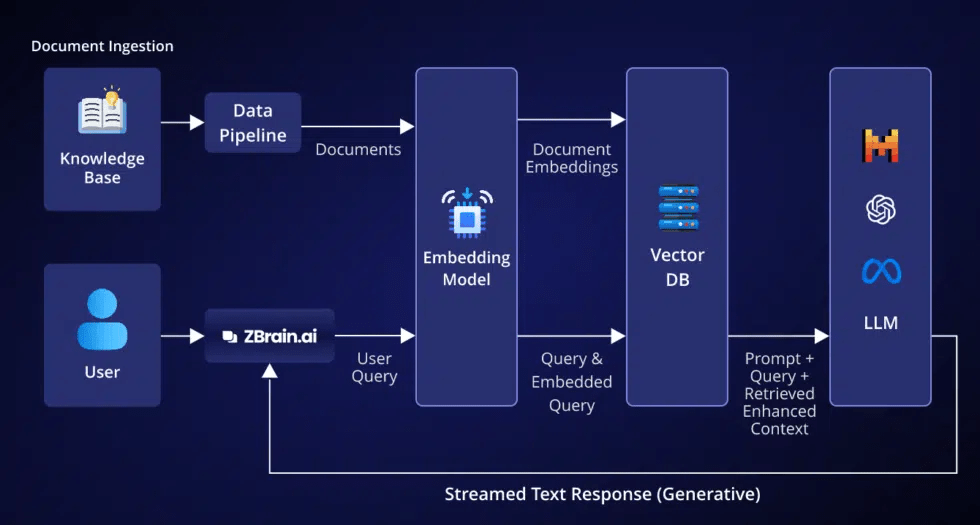
Understanding Retrieval-Augmented Generation (RAG)
Retrieval-augmented generation is a method that combines two powerful techniques: information retrieval and generative AI. It allows AI models to pull specific information from external data sources and use it to generate contextually relevant responses. Unlike traditional generative models, which rely entirely on pre-trained datasets, RAG dynamically accesses external databases, knowledge repositories, or even real-time data during inference.
For enterprise AI development, this opens up new possibilities for creating AI solutions that are more accurate and able to respond to real-world scenarios with up-to-date information. Instead of training a model from scratch or relying solely on static data, businesses can incorporate real-time insights, making their AI systems more adaptive and scalable.
Key Benefits of RAG in Enterprise AI Development
1. Enhanced Accuracy and Relevance
One of the main challenges in enterprise AI development is ensuring the accuracy and relevance of AI-generated outputs. Traditional AI models often struggle to generate precise answers when faced with specific or uncommon queries because they depend on pre-existing datasets. By integrating retrieval-augmented generation, AI models can access real-time, relevant information from external databases, leading to significantly more accurate responses.
For example, in industries like finance, healthcare, or customer service, where up-to-date and accurate information is critical, RAG ensures that AI systems stay relevant and responsive. Enterprises benefit from AI systems that not only generate responses but also provide fact-checked, context-aware insights.
2. Reducing the Need for Extensive Data Training
Building and maintaining AI models requires vast amounts of data, time, and computational resources. Enterprise AI development can be slow and expensive because it often requires large datasets and extensive training to keep models accurate and useful. Retrieval-augmented generation can help reduce the need for large-scale data training by allowing the AI system to retrieve information dynamically from external sources.
This not only accelerates the development cycle but also makes AI systems more lightweight and adaptable. By reducing the dependency on vast datasets, enterprises can quickly deploy AI models without the need for continuous and costly retraining.
3. Improving Scalability
Enterprise AI development at scale can be challenging, especially when dealing with rapidly evolving data environments. Models trained on static datasets often become obsolete quickly, requiring constant updates and retraining. Retrieval-augmented generation provides a way to scale AI solutions without the heavy burden of retraining by ensuring that models can draw on external, up-to-date information.
As organizations grow and face an increasing amount of diverse data, RAG-based AI systems can easily scale to handle more complex queries and larger datasets. This scalability ensures that enterprises can continue to develop AI solutions without hitting the limitations posed by traditional, static models.
4. Cost Efficiency
The financial aspect of enterprise AI development is significant. The cost of data collection, annotation, and training AI models is a major barrier for many companies. Retrieval-augmented generation reduces these costs by minimizing the need for exhaustive data collection and model training.
With RAG, businesses can build AI systems that utilize external data, reducing the need for expensive infrastructure to store and process large datasets. This makes it easier for enterprises to adopt AI technologies and scale their solutions without the heavy financial burden often associated with traditional AI development.
Use Cases for Retrieval-Augmented Generation in Enterprise AI
1. Customer Support Automation
One of the most immediate applications of retrieval-augmented generation in enterprise AI development is customer support automation. AI systems can retrieve relevant, up-to-date answers from databases or knowledge bases, allowing them to handle customer queries more accurately. This leads to more efficient support, improved customer satisfaction, and reduced workload for human agents.
2. Data-Driven Decision Making
In industries like finance, logistics, and healthcare, decision-making relies heavily on accurate and timely information. RAG enables enterprise AI systems to access and process real-time data from various sources, offering decision-makers actionable insights. This ensures that the information used in decision-making processes is current, reducing risks and enhancing strategic outcomes.
3. Knowledge Management
Many enterprises struggle with effectively managing and utilizing their internal knowledge. With RAG, AI systems can tap into internal and external knowledge repositories, ensuring that employees can quickly retrieve the information they need. This improves collaboration and efficiency across teams while also preserving institutional knowledge.
Overcoming Challenges in Implementing RAG for Enterprise AI
While retrieval-augmented generation presents numerous benefits, implementing it within the enterprise AI development ecosystem comes with its own set of challenges. Integration with existing data systems, security concerns around external data retrieval, and ensuring the quality of retrieved information are critical issues that enterprises need to address. However, by leveraging robust data governance and monitoring frameworks, these challenges can be managed effectively.
Enterprises also need to invest in AI infrastructure that supports retrieval-augmented generation. This may involve updating data systems and adopting more flexible AI development platforms that can easily interface with external data sources.
Conclusion
Retrieval-augmented generation offers a powerful method to accelerate enterprise AI development by enhancing accuracy, reducing training data requirements, improving scalability, and cutting costs. By allowing AI models to dynamically access real-time information, RAG provides a path for enterprises to develop AI systems that are more adaptive, efficient, and aligned with real-world needs. As businesses continue to prioritize AI development, the adoption of RAG could prove essential in driving innovation and maintaining a competitive edge in an increasingly AI-driven world.


Leave a comment