The integration of artificial intelligence in healthcare is revolutionizing how medical professionals diagnose, treat, and manage patient care. AI technologies are rapidly evolving, leading to enhanced efficiency, accuracy, and personalization in healthcare delivery. This article explores the impact of AI in healthcare, highlighting its applications, benefits, challenges, and future potential.
Understanding AI in Healthcare
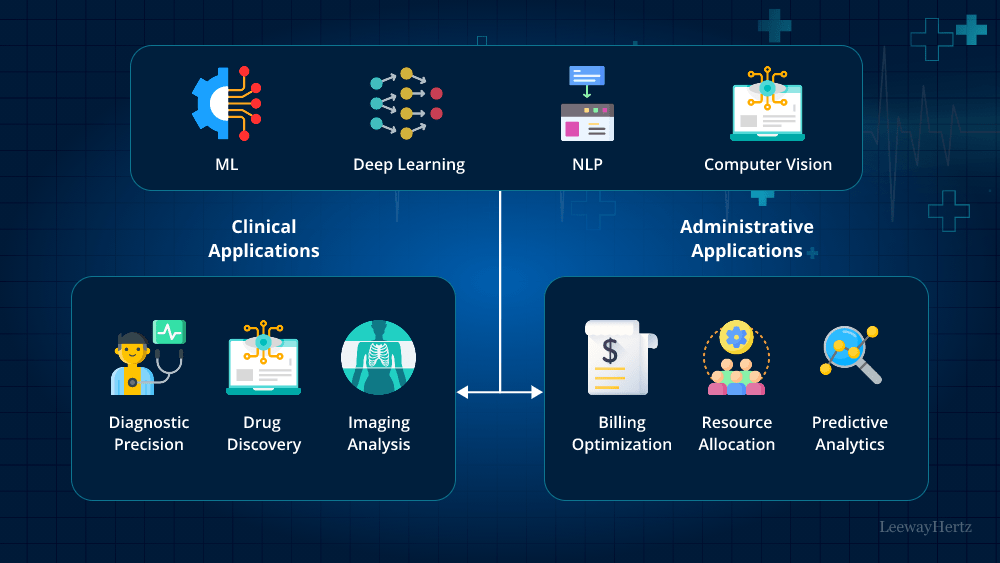
AI in healthcare refers to the use of machine learning algorithms, natural language processing, and other advanced technologies to analyze complex medical data. These technologies enable healthcare professionals to make better decisions, improve patient outcomes, and streamline operational processes. From predictive analytics to robotic surgery, AI is transforming various facets of healthcare.
Applications of AI in Healthcare
1. Diagnostic Assistance
One of the most significant applications of AI in healthcare is its role in diagnostic assistance. Machine learning algorithms can analyze medical images, such as X-rays, MRIs, and CT scans, with remarkable accuracy. By comparing patient images to vast databases of previous cases, AI can help identify diseases at earlier stages than traditional methods. This capability is particularly beneficial in detecting conditions like cancer, where early diagnosis can significantly impact treatment success.
2. Personalized Medicine
AI in healthcare is enabling the development of personalized medicine, which tailors treatment plans based on individual patient characteristics. By analyzing genetic data, medical histories, and lifestyle factors, AI can help healthcare providers recommend the most effective therapies for each patient. This approach not only improves treatment outcomes but also minimizes the risk of adverse effects from medications.
3. Predictive Analytics
Predictive analytics is another vital application of AI in healthcare. By leveraging large datasets, AI algorithms can forecast potential health issues before they arise. For instance, predictive models can identify patients at high risk for conditions such as diabetes or heart disease, allowing for early intervention. This proactive approach can lead to improved patient outcomes and reduced healthcare costs.
4. Virtual Health Assistants
The rise of virtual health assistants powered by AI is transforming patient engagement. These digital tools can provide 24/7 support, answering questions, scheduling appointments, and sending medication reminders. By facilitating communication between patients and healthcare providers, virtual health assistants enhance patient experience and encourage adherence to treatment plans.
5. Drug Discovery and Development
AI is also making significant strides in drug discovery and development. Traditional methods of developing new medications are often time-consuming and costly. However, AI can analyze vast amounts of biomedical data to identify potential drug candidates more efficiently. This capability not only accelerates the development process but also increases the likelihood of successful outcomes.
Benefits of AI in Healthcare
The benefits of incorporating AI in healthcare are manifold. First and foremost, AI enhances the accuracy of diagnoses, which can lead to better treatment decisions. Furthermore, by automating routine tasks, AI allows healthcare professionals to focus more on patient care rather than administrative duties.
Additionally, AI-driven insights can lead to more effective resource management, reducing waste and improving operational efficiency. This aspect is particularly crucial in today’s healthcare environment, where resources are often stretched thin. Ultimately, the integration of AI in healthcare can lead to improved patient satisfaction and better health outcomes.
Challenges and Considerations
Despite the numerous advantages, the implementation of AI in healthcare does come with challenges. One significant concern is data privacy and security. As AI systems require access to vast amounts of sensitive patient data, safeguarding this information is paramount. Healthcare organizations must ensure compliance with regulations and adopt robust security measures to protect patient confidentiality.
Another challenge is the potential for bias in AI algorithms. If the data used to train these algorithms is not representative of the diverse patient population, it can lead to skewed results. Addressing this issue requires careful consideration of data diversity and ongoing evaluation of AI systems to ensure fairness.
Moreover, the integration of AI into healthcare workflows requires significant investment in technology and training. Healthcare providers must be equipped with the necessary skills to leverage AI tools effectively. This calls for ongoing education and collaboration between technologists and healthcare professionals.
The Future of AI in Healthcare
The future of AI in healthcare is promising. As technology continues to advance, we can expect even more innovative applications of AI in clinical settings. The potential for AI to analyze unstructured data, such as clinical notes and research articles, could further enhance decision-making processes.
Moreover, the use of AI in telemedicine is likely to expand, making healthcare more accessible, especially in underserved areas. By bridging the gap between patients and providers, AI can facilitate timely interventions and improve overall health outcomes.
In conclusion, AI in healthcare is not just a trend; it is a transformative force that is reshaping the industry. By improving diagnostic accuracy, personalizing treatment plans, and enhancing patient engagement, AI is poised to revolutionize healthcare delivery. While challenges exist, the potential benefits far outweigh the obstacles, making AI an indispensable tool in the future of healthcare. Embracing these technologies will be crucial for healthcare providers aiming to deliver high-quality, patient-centered care in an increasingly complex healthcare landscape.
 New Tech news
Leave a comment