Generative AI is revolutionizing various industries by enabling machines to create content, designs, and solutions that mimic human creativity. If you’re looking to understand how to build a generative AI solution, this guide will walk you through the essential steps. From understanding the technology to implementing it effectively, we’ll cover everything you need to know.
Understanding Generative AI
Before diving into the steps of building a generative AI solution, it’s crucial to understand what generative AI is. At its core, generative AI refers to algorithms that can generate new content based on training data. This includes text, images, music, and even code. Key technologies behind generative AI include deep learning, neural networks, and natural language processing.
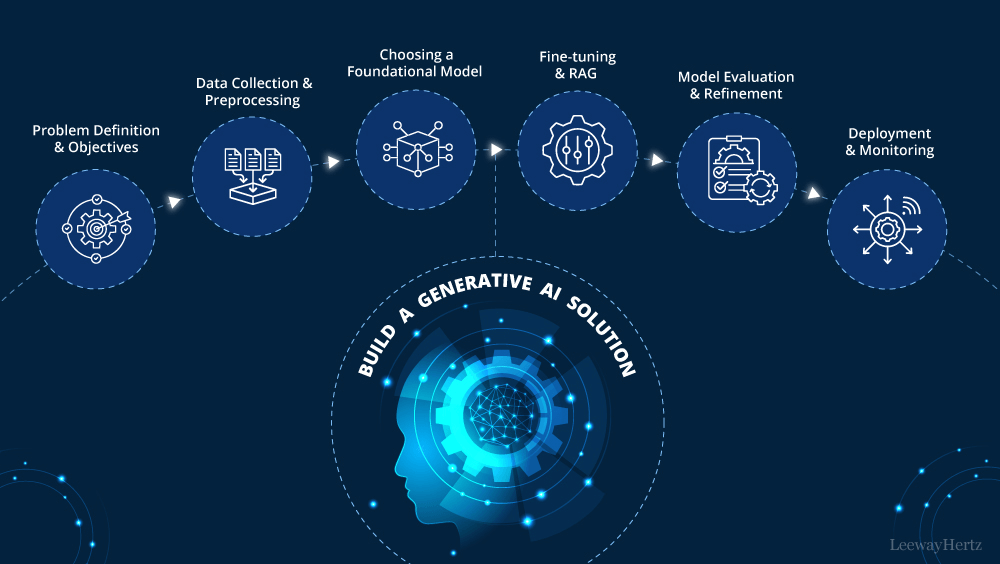
Step 1: Define Your Goals
The first step in how to build a generative AI solution is defining your goals. What do you want to achieve? Are you looking to generate text, create images, or perhaps develop a chatbot? Clearly outlining your objectives will guide your development process and help you select the appropriate tools and technologies.
Step 2: Gather and Prepare Data
Data is the backbone of any AI solution. For generative models, you’ll need a large dataset that aligns with your goals. If you aim to generate text, consider using books, articles, or web content. For image generation, high-quality images that represent your target output are essential.
Once you’ve gathered your data, it’s important to preprocess it. This can include cleaning the data, normalizing formats, and splitting it into training and validation sets. Properly prepared data is crucial for the performance of your generative AI solution.
Step 3: Choose the Right Model
Next, you need to select a model that suits your goals. There are several types of generative models, including:
- Generative Adversarial Networks (GANs): Best for image generation, GANs consist of two networks—the generator and the discriminator—that work against each other.
- Variational Autoencoders (VAEs): These are useful for generating diverse outputs and work well for both images and other data types.
- Transformers: Ideal for text generation, transformers have shown remarkable capabilities in producing coherent and contextually relevant text.
Selecting the right model is vital to the success of your generative AI solution.
Step 4: Train Your Model
With your data and model in place, it’s time to train your generative AI solution. Training involves feeding your model the prepared dataset and adjusting its parameters to minimize errors. This step requires a significant amount of computational power, so ensure you have the necessary resources, whether through local machines or cloud services.
During training, you’ll monitor the model’s performance using validation datasets. This helps in fine-tuning the model and preventing overfitting. Experiment with hyperparameters like learning rate and batch size to optimize the training process.
Step 5: Evaluate and Fine-tune
Once your model is trained, it’s crucial to evaluate its performance. Use metrics that align with your goals, such as accuracy for text generation or image quality for visual outputs. This evaluation helps you identify areas for improvement.
If the results are not satisfactory, consider fine-tuning the model. This could involve retraining with more data, adjusting hyperparameters, or even experimenting with different model architectures. The goal is to enhance the performance of your generative AI solution.
Step 6: Implement and Deploy
After fine-tuning your model, it’s time to implement your generative AI solution. This involves integrating the model into an application or service where users can interact with it. Ensure that the user interface is intuitive and accessible.
Deployment may require additional considerations, such as scalability and security. Choose an appropriate platform for hosting your model, ensuring it can handle user requests efficiently. Proper monitoring and maintenance will also be necessary to ensure long-term performance.
Step 7: Gather Feedback and Iterate
Once your generative AI solution is live, gathering user feedback is essential. This feedback will help you understand how well the model meets user needs and where it might fall short. Use this information to make iterative improvements.
Continuous learning is a key aspect of maintaining a successful generative AI solution. As you gather more data and insights, refine your model to keep it relevant and effective.
Conclusion
Building a generative AI solution may seem daunting, but by following these steps—defining your goals, gathering data, choosing the right model, training, evaluating, implementing, and iterating—you can create a powerful tool that harnesses the creativity of AI. Whether you aim to generate text, images, or other forms of content, understanding how to build a generative AI solution will empower you to innovate and transform your ideas into reality. Start your journey today and unlock the potential of generative AI.
 New Tech news
Leave a comment