Introduction
In the rapidly evolving field of artificial intelligence, fine-tuning large models is crucial for achieving optimal performance across various tasks. Traditional fine-tuning methods, however, often require substantial computational resources and can be inefficient, especially when dealing with vast neural networks. This is where Parameter-efficient Fine-tuning (PEFT) comes into play. PEFT is a more efficient approach that reduces the need for massive resources while maintaining high performance, making it an increasingly popular choice in AI development.
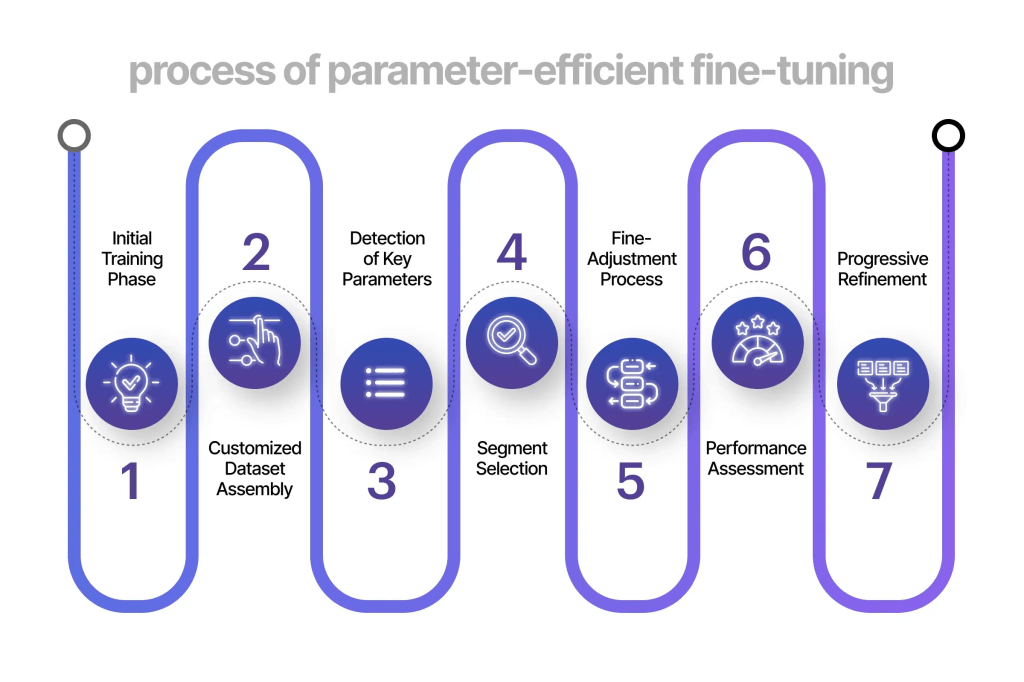
What is Parameter-Efficient Fine-Tuning (PEFT)?
Parameter-Efficient Fine-Tuning (PEFT) is an approach that aims to fine-tune pre-trained models by adjusting only a small subset of the model’s parameters, rather than the entire network. Traditional fine-tuning involves updating all the weights in a model, which can be computationally expensive and time-consuming, especially for large-scale models like transformers. PEFT, on the other hand, focuses on optimizing specific parameters that have the most impact on the model’s performance, thereby reducing the overall resource requirements.
Why Parameter-Efficient Fine-Tuning (PEFT) Matters
The primary advantage of Parameter-Efficient Fine-Tuning is its ability to significantly reduce the computational costs associated with fine-tuning large models. This is particularly important in scenarios where computational resources are limited or where quick iteration cycles are needed. By only adjusting a small fraction of the model’s parameters, PEFT not only speeds up the fine-tuning process but also makes it more accessible for researchers and developers working with limited hardware.
Moreover, PEFT allows models to generalize better with less data, as it avoids overfitting by not over-adjusting the entire set of parameters. This efficiency makes PEFT especially valuable in domains such as natural language processing, computer vision, and other AI applications where fine-tuning large models has become the norm.
Key Techniques in Parameter-Efficient Fine-Tuning (PEFT)
Several techniques fall under the umbrella of Parameter-Efficient Fine-Tuning, each with its own approach to optimizing fine-tuning processes. Here are some of the most common methods:
1. Adapters
Adapters are small neural networks inserted between layers of a larger pre-trained model. During fine-tuning, only the parameters of these adapters are updated, while the rest of the model remains unchanged. This drastically reduces the number of parameters that need adjustment, making the fine-tuning process much more efficient. Adapters are especially useful in scenarios where multiple tasks are being handled by the same base model, allowing for task-specific adjustments without retraining the entire network.
2. Low-Rank Adaptation (LoRA)
Low-Rank Adaptation (LoRA) is a PEFT method that focuses on modifying a subset of parameters in a way that represents them as a low-rank matrix. This approach reduces the number of parameters by focusing on the most influential aspects of the weight matrices, thereby achieving efficiency without significant loss in performance. LoRA is particularly beneficial when working with transformer models, as it targets the core operations that consume the most computational power.
3. Prompt Tuning
Prompt tuning involves adjusting only the input prompts to guide the model’s behavior, rather than changing the model parameters themselves. This is done by optimizing a small number of additional tokens that are added to the input data. The model remains fixed, and the tuning process is focused on finding the optimal prompts that lead to the desired outputs. This method is particularly useful in scenarios where maintaining the integrity of the pre-trained model is essential.
Advantages of Parameter-Efficient Fine-Tuning (PEFT)
Parameter-Efficient Fine-Tuning offers several benefits that make it a superior choice over traditional fine-tuning methods:
- Reduced Resource Requirements: By updating only a fraction of the model’s parameters, PEFT significantly cuts down on computational costs and memory usage.
- Faster Fine-Tuning: PEFT enables quicker adaptation of models to new tasks, which is particularly valuable in environments where rapid iteration is needed.
- Improved Generalization: With fewer parameters being adjusted, there is a lower risk of overfitting, leading to models that perform well on a wider range of data.
- Scalability: PEFT makes it feasible to fine-tune extremely large models on regular hardware, making advanced AI models more accessible to a broader audience.
Challenges and Considerations
While Parameter-Efficient Fine-Tuning offers numerous advantages, it is not without challenges. One key consideration is determining which parameters to fine-tune, as this can vary greatly depending on the model and task. Additionally, while PEFT reduces the computational burden, it may require careful tuning and experimentation to achieve optimal results, especially in complex or highly specialized tasks.
Conclusion
Parameter-Efficient Fine-Tuning (PEFT) represents a significant advancement in the fine-tuning of large AI models, providing a more efficient, cost-effective, and scalable approach. By focusing on optimizing only the most critical parameters, PEFT allows for rapid adaptation and deployment of AI models without the hefty resource demands typically associated with traditional fine-tuning. As the AI landscape continues to evolve, techniques like PEFT are likely to play an increasingly important role in making powerful AI tools accessible and effective across a wide range of applications.
 New Tech news
Leave a comment