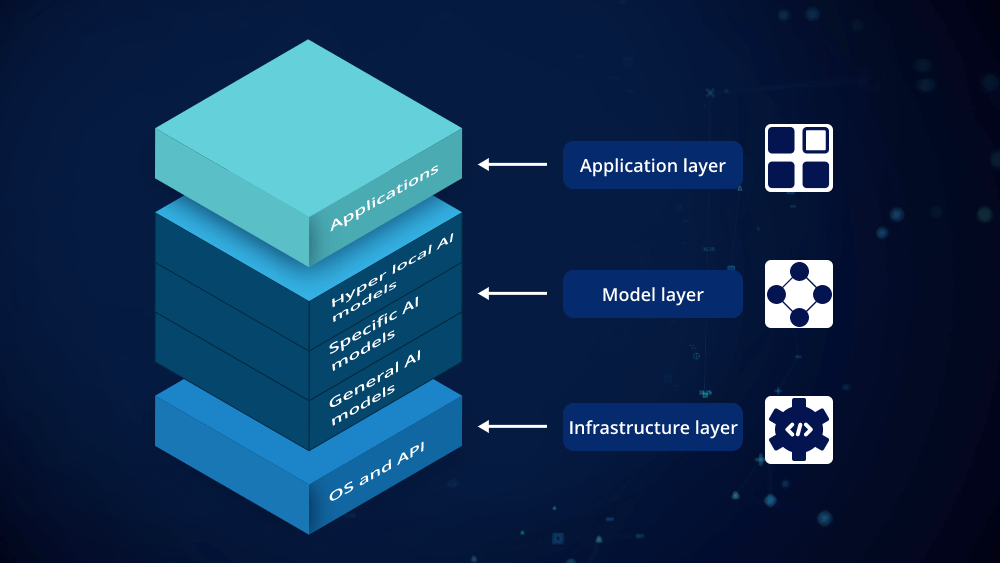
Generative AI has emerged as one of the most transformative technologies in recent years, driving advancements across various industries. The success of these AI systems relies on a robust generative AI tech stack that encompasses several critical components. This article explores the core elements of the generative AI tech stack, including frameworks, infrastructure, models, and applications, providing a clear and straightforward overview of each aspect.
Frameworks: Building Blocks of Generative AI
Frameworks are essential to the generative AI tech stack as they provide the foundational tools and libraries needed to develop and deploy AI models. These frameworks offer pre-built functions and utilities that simplify the complex process of training and fine-tuning generative models. Some of the most popular frameworks in the generative AI tech stack include:
- TensorFlow: Developed by Google, TensorFlow is a comprehensive open-source framework that supports a wide range of machine learning and deep learning tasks. Its flexibility and extensive library of pre-built components make it a popular choice for developing generative AI models.
- PyTorch: Created by Facebook’s AI Research lab, PyTorch is known for its dynamic computational graph and ease of use. It is particularly favored for research and prototyping of generative models due to its intuitive design and strong community support.
- Hugging Face Transformers: This specialized library focuses on natural language processing (NLP) and provides a collection of pre-trained models and tools. It is widely used for creating generative models in NLP, such as GPT (Generative Pre-trained Transformer) variants.
These frameworks are instrumental in the generative AI tech stack, offering developers the tools needed to build, test, and refine generative models efficiently.
Infrastructure: Supporting the Generative AI Ecosystem
The infrastructure of the generative AI tech stack encompasses the hardware and cloud services required to train and deploy AI models. Effective infrastructure is crucial for handling the computational demands of generative models, which often involve processing large datasets and performing complex calculations.
- Graphics Processing Units (GPUs): GPUs are critical for accelerating the training of generative models. Their parallel processing capabilities enable faster computation of the vast amounts of data required by these models. Nvidia’s CUDA-enabled GPUs are particularly popular in the generative AI tech stack for their high performance.
- Cloud Platforms: Cloud services such as Amazon Web Services (AWS), Google Cloud Platform (GCP), and Microsoft Azure offer scalable computing resources that are essential for training large generative models. These platforms provide the flexibility to scale resources up or down based on demand, making them a preferred choice for many AI practitioners.
- Data Storage Solutions: Efficient data storage solutions are vital for managing the large datasets used in training generative models. Services like AWS S3 and Google Cloud Storage provide scalable and reliable storage options that integrate seamlessly with other components of the generative AI tech stack.
By leveraging robust infrastructure, organizations can ensure that their generative AI models are trained efficiently and can be deployed effectively.
Models: The Heart of Generative AI
Generative models are the core of the generative AI tech stack, responsible for generating new data that resembles the training data. These models come in various forms, each with unique characteristics and applications.
- Generative Adversarial Networks (GANs): GANs consist of two neural networks—the generator and the discriminator—that work in tandem to produce realistic synthetic data. GANs are widely used in image generation, video synthesis, and art creation.
- Variational Autoencoders (VAEs): VAEs are generative models that learn to encode data into a latent space and then decode it to generate new samples. They are commonly used in applications such as image denoising and anomaly detection.
- Transformers: Transformers, particularly the GPT series, have revolutionized natural language generation. These models use self-attention mechanisms to generate coherent and contextually relevant text. They are used in applications ranging from chatbots to content creation.
Each model type within the generative AI tech stack offers unique capabilities, enabling diverse applications and innovations.
Applications: Transforming Industries with Generative AI
The applications of generative AI are vast and continue to expand as the technology evolves. Leveraging the generative AI tech stack, businesses and researchers are finding innovative solutions to complex problems across various domains.
- Content Creation: Generative AI models are used to produce high-quality written content, including articles, stories, and marketing copy. This technology also extends to creating images, music, and even video content, enabling new forms of digital artistry.
- Healthcare: In healthcare, generative AI is employed to design new drugs, simulate protein structures, and personalize treatment plans. It helps in analyzing medical images and predicting patient outcomes based on historical data.
- Entertainment and Media: Generative AI is transforming the entertainment industry by creating realistic visual effects, generating character animations, and enhancing user experiences in video games and virtual reality.
- Finance: In the financial sector, generative AI models assist in predicting market trends, detecting fraudulent activities, and personalizing financial advice for clients.
By integrating generative AI into their workflows, organizations can achieve significant advancements and efficiencies, unlocking new opportunities and driving innovation.
Conclusion
The generative AI tech stack is a complex and multifaceted ecosystem comprising frameworks, infrastructure, models, and applications. Each component plays a critical role in enabling the development and deployment of powerful generative AI systems. Understanding this tech stack is essential for harnessing the full potential of generative AI and driving progress in various fields. As the technology continues to advance, its impact on industries and everyday life is set to become even more profound, paving the way for exciting future innovations.
 New Tech news
Leave a comment