Introduction
In today’s data-driven world, businesses and organizations are constantly seeking innovative ways to extract meaningful insights from vast amounts of data. One such innovation that is revolutionizing the field is AI agents for data analysis. These intelligent systems are transforming how we interpret data, make decisions, and drive strategies, offering powerful capabilities that go beyond traditional data analysis methods. This article delves into what AI agents for data analysis are, their benefits, applications, and how they are shaping the future of data-driven decision-making.
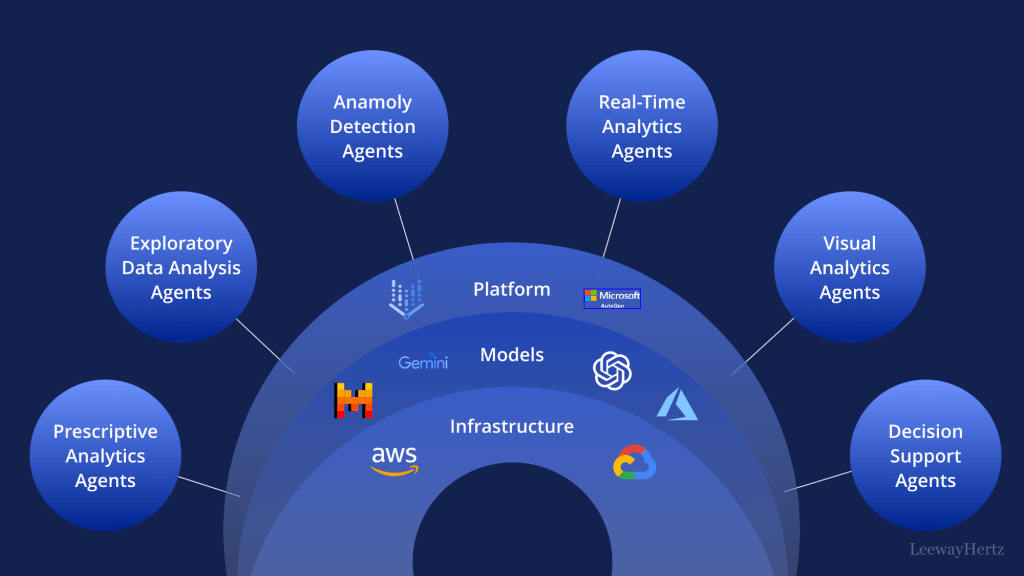
What are AI Agents for Data Analysis?
AI agents for data analysis are specialized artificial intelligence systems designed to automate and enhance the process of data examination. Unlike conventional software, AI agents can learn, adapt, and improve over time, making them incredibly efficient at identifying patterns, predicting trends, and providing actionable insights. They can handle vast datasets from various sources, clean and process the information, and apply advanced algorithms to uncover insights that might be missed by human analysts.
Benefits of AI Agents for Data Analysis
1. Speed and Efficiency
One of the primary advantages of using AI agents for data analysis is their ability to process large volumes of data at high speed. These agents can quickly sift through data, eliminating the need for time-consuming manual analysis. This speed not only accelerates decision-making processes but also allows organizations to respond swiftly to changing market conditions or emerging trends.
2. Accuracy and Precision
AI agents for data analysis are equipped with advanced algorithms that minimize errors, enhancing the accuracy and precision of the analysis. They can detect anomalies, outliers, and subtle patterns that might be overlooked by human analysts, leading to more reliable insights and recommendations.
3. Scalability
As organizations grow, the volume of data they generate and collect also increases. AI agents for data analysis offer scalable solutions that can handle data of any size, making them ideal for businesses of all sizes, from startups to large enterprises. This scalability ensures that the analysis remains consistent and effective, regardless of data volume.
4. Cost-Effectiveness
Implementing AI agents for data analysis can lead to significant cost savings. By automating repetitive and labor-intensive tasks, these agents reduce the need for large data analysis teams and minimize the risk of costly errors. Over time, the investment in AI agents can yield high returns through improved efficiency and better decision-making.
Applications of AI Agents for Data Analysis
1. Financial Services
In the financial sector, AI agents for data analysis are used to detect fraudulent activities, assess credit risks, and optimize investment strategies. By analyzing transaction patterns and customer data, these agents can identify suspicious activities in real-time, protecting organizations and their customers from financial losses.
2. Healthcare
AI agents for data analysis are making significant strides in healthcare by analyzing patient data to improve diagnosis, treatment plans, and patient outcomes. They can process medical records, genetic information, and research data to provide personalized treatment recommendations, predict disease outbreaks, and optimize resource allocation in hospitals.
3. Marketing and Sales
Businesses leverage AI agents for data analysis to gain insights into customer behavior, preferences, and purchasing patterns. These agents can analyze data from social media, websites, and sales records to create targeted marketing campaigns, enhance customer engagement, and improve sales strategies.
4. Manufacturing
In manufacturing, AI agents for data analysis are used to predict equipment failures, optimize production schedules, and improve supply chain management. By analyzing data from sensors, machines, and production lines, these agents help in reducing downtime, enhancing productivity, and ensuring product quality.
Challenges and Future of AI Agents for Data Analysis
While AI agents for data analysis offer numerous benefits, there are challenges to consider. Data privacy and security are major concerns, as these agents require access to sensitive information. Ensuring that AI agents are transparent, unbiased, and compliant with regulations is crucial to their successful implementation.
The future of AI agents for data analysis looks promising, with advancements in machine learning, natural language processing, and deep learning paving the way for more sophisticated and capable systems. As these technologies evolve, AI agents will become even more integral to decision-making processes across various industries, offering unprecedented levels of insight and automation.
Conclusion
AI agents for data analysis are reshaping how we handle and interpret data, providing powerful tools for faster, more accurate, and scalable analysis. Their applications across different sectors demonstrate their versatility and potential to drive data-driven decision-making. As technology continues to advance, the role of AI agents in data analysis will only grow, making them an indispensable part of the modern business landscape.
By embracing AI agents for data analysis, organizations can unlock new opportunities, enhance their operational efficiency, and stay ahead in an increasingly competitive environment. Whether it’s in finance, healthcare, marketing, or manufacturing, AI agents are proving to be valuable allies in the quest for actionable insights and informed decision-making.
 New Tech news
Leave a comment