Anomaly detection plays a crucial role in various industries, helping identify unexpected events, patterns, or data points that differ from the norm. With the rise of technology, AI in anomaly detection has become a game-changer, providing advanced capabilities that traditional methods lack. This article explores how AI is revolutionizing anomaly detection, its applications, and the benefits it brings to different sectors.
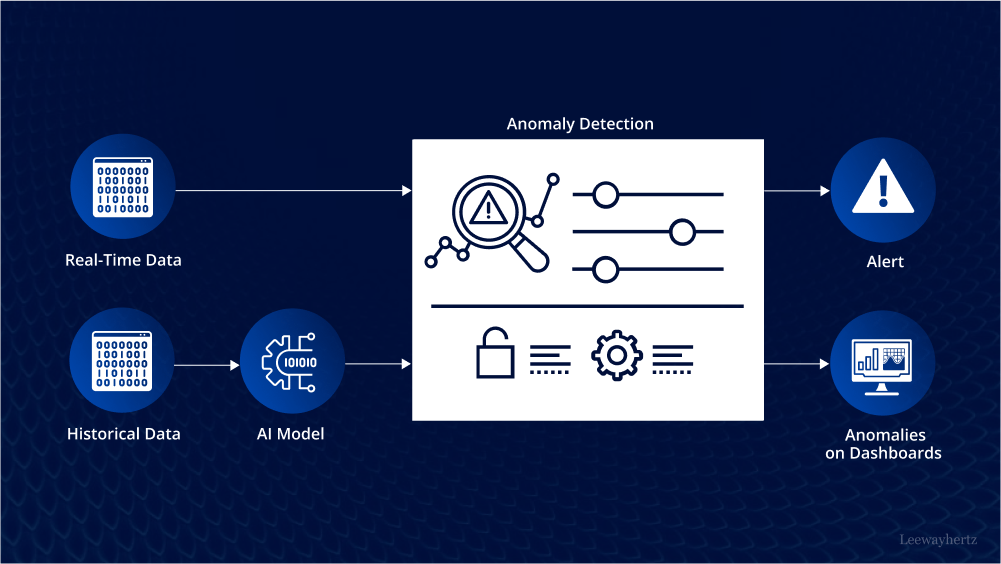
Understanding Anomaly Detection and Its Importance
Anomaly detection refers to identifying unusual patterns that do not conform to expected behavior. This process is essential in numerous fields, including finance, healthcare, cybersecurity, manufacturing, and retail. Detecting anomalies early can prevent potential threats, reduce losses, and maintain system integrity.
Traditional anomaly detection methods often rely on statistical analysis, which may struggle with complex datasets and dynamic environments. This is where AI in anomaly detection comes into play, offering more sophisticated techniques that adapt to changing data patterns.
How AI Enhances Anomaly Detection
AI in anomaly detection leverages machine learning, deep learning, and other AI technologies to analyze large datasets quickly and accurately. These AI-powered systems can detect subtle changes that traditional methods might miss, making them highly effective for real-time monitoring and prediction.
1. Machine Learning Algorithms
Machine learning (ML) algorithms are at the core of AI in anomaly detection. These algorithms learn from historical data, identify normal patterns, and flag any deviations as anomalies. Supervised, unsupervised, and semi-supervised learning techniques can be applied depending on the availability of labeled data.
- Supervised Learning: This approach uses labeled data to train the model on what constitutes normal and abnormal behavior. Although effective, it requires a large amount of labeled data, which is not always available.
- Unsupervised Learning: Unsupervised learning does not need labeled data, making it suitable for situations where anomalies are rare or unknown. The algorithm learns normal patterns independently and identifies outliers as anomalies.
- Semi-supervised Learning: This method combines elements of both supervised and unsupervised learning, using a small amount of labeled data along with a larger set of unlabeled data to improve detection accuracy.
2. Deep Learning Techniques
Deep learning, a subset of AI, uses neural networks with multiple layers to process complex data. For anomaly detection, deep learning models like Autoencoders, Long Short-Term Memory (LSTM) networks, and Convolutional Neural Networks (CNNs) are commonly used.
- Autoencoders: These are neural networks trained to reconstruct input data. When an anomaly occurs, the reconstruction error is high, signaling an unusual event.
- LSTM Networks: LSTM networks are effective for detecting anomalies in time-series data, such as financial transactions or equipment monitoring, due to their ability to remember long-term dependencies.
- CNNs: Convolutional Neural Networks are useful for image and video data, identifying anomalies in visual patterns, which is beneficial in areas like surveillance and quality control.
Applications of AI in Anomaly Detection
The applications of AI in anomaly detection are vast, spanning multiple industries and use cases:
1. Financial Sector
AI in anomaly detection helps identify fraudulent transactions, market manipulation, and abnormal trading activities. Machine learning algorithms can analyze millions of transactions in real time, flagging suspicious activities that require further investigation.
2. Healthcare
In healthcare, AI-driven anomaly detection assists in identifying unusual patient conditions, predicting disease outbreaks, and monitoring medical equipment. Early detection of anomalies in patient data can lead to timely interventions, improving patient outcomes.
3. Cybersecurity
AI in anomaly detection is crucial for cybersecurity, where it helps identify unusual network activity, detect malware, and prevent data breaches. AI models can continuously learn and adapt to new threats, providing a robust defense against evolving cyberattacks.
4. Manufacturing
In manufacturing, AI-based anomaly detection monitors equipment performance, identifying potential failures before they occur. This predictive maintenance approach reduces downtime, improves productivity, and saves costs by preventing unexpected equipment breakdowns.
5. Retail and E-commerce
Retailers use AI in anomaly detection to monitor inventory, sales patterns, and customer behavior. Detecting anomalies in sales data can help identify fraudulent activities, stock discrepancies, or even emerging trends that require attention.
Benefits of AI in Anomaly Detection
The integration of AI in anomaly detection brings numerous benefits, including:
- Real-time Detection: AI models can process and analyze data in real time, providing instant alerts when anomalies occur.
- Scalability: AI systems can handle large volumes of data, making them suitable for industries with extensive data sets like finance and healthcare.
- Improved Accuracy: AI models continuously learn from new data, improving their accuracy in detecting anomalies over time.
- Cost Efficiency: Early detection of anomalies can prevent costly errors, fraud, or system failures, saving organizations significant resources.
Conclusion
AI in anomaly detection is revolutionizing how industries monitor and manage data irregularities. By utilizing machine learning, deep learning, and other AI technologies, organizations can detect anomalies faster, more accurately, and with greater efficiency than ever before. As AI continues to evolve, its role in anomaly detection will only become more critical, driving advancements across multiple sectors and ensuring safer, more reliable operations.
 New Tech news
Leave a comment