Retrieval-Augmented Generation (RAG) is a powerful AI approach that combines the strengths of retrieval-based models and generative models to provide more accurate, context-aware responses. As AI continues to evolve, Advanced RAG is gaining traction for its enhanced architecture, innovative techniques, and diverse applications. This article delves into the intricacies of Advanced RAG, exploring its architecture, key techniques, real-world applications, and development strategies.
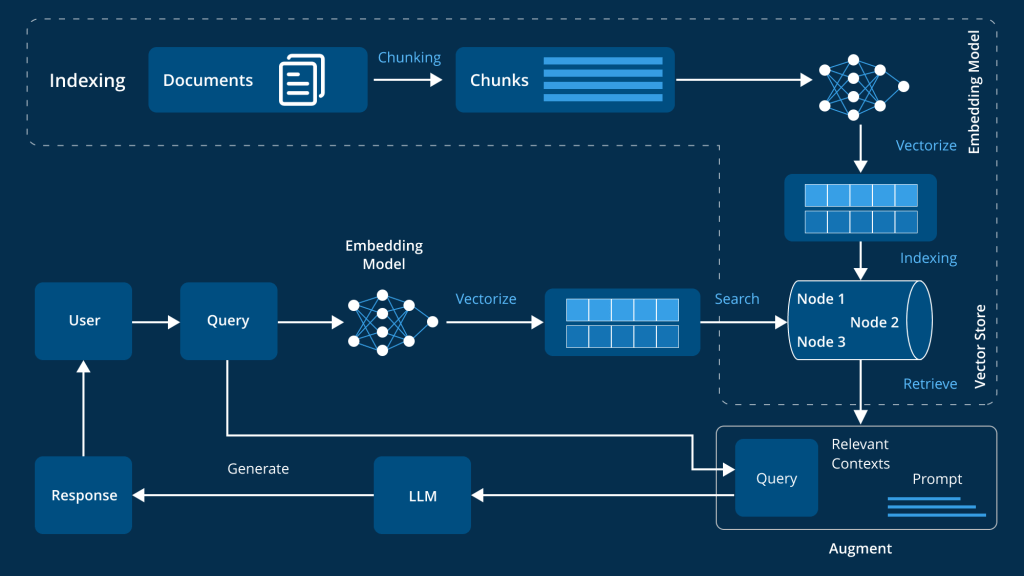
Understanding Advanced RAG Architecture
The core architecture of Advanced RAG combines two main components: the retriever and the generator. This architecture allows AI systems to generate more relevant and contextually accurate responses by leveraging external knowledge sources. Here’s a deeper look into each component:
- Retriever: The retriever identifies relevant documents or passages from a large dataset or database. It uses techniques like dense retrieval, sparse retrieval, or a combination of both to find the most pertinent information. In Advanced RAG, retrievers are often fine-tuned on domain-specific data to enhance accuracy.
- Generator: The generator is responsible for producing the final output by synthesizing information from the retrieved documents. Typically, this is achieved using generative models such as GPT-3, BERT, or T5. Advanced RAG leverages state-of-the-art generative models that are fine-tuned with domain-specific data, ensuring that the generated output is coherent and contextually aligned with the query.
- Fusion Mechanism: Advanced RAG utilizes sophisticated fusion mechanisms to combine retrieved data and generated text seamlessly. Techniques like cross-attention layers allow the model to merge information effectively, ensuring that the generated response accurately reflects the retrieved knowledge.
Techniques in Advanced RAG
Advanced RAG employs various cutting-edge techniques to optimize retrieval and generation processes. These techniques make the system more robust, adaptable, and efficient.
- Dense Retrieval Models: Dense retrieval models, such as Dual Encoder and ColBERT, use neural embeddings to match queries with relevant documents. Advanced RAG models often utilize dense retrievers to improve the retrieval quality, especially when dealing with large datasets.
- Hybrid Retrieval: By combining sparse and dense retrieval methods, Advanced RAG enhances retrieval precision. Hybrid models use traditional keyword matching (sparse) alongside neural embeddings (dense) to cover a broader range of query-document matching scenarios.
- Fine-Tuning and Domain Adaptation: Fine-tuning is crucial in Advanced RAG as it adapts the retriever and generator to specific use cases. Domain adaptation helps these models perform better in specialized fields, such as legal, medical, or financial sectors, where standard models might fall short.
- Knowledge Distillation: This technique helps in reducing the complexity of the model without compromising performance. In Advanced RAG, knowledge distillation can simplify the retriever or generator, making the system more efficient and faster while maintaining high accuracy.
Applications of Advanced RAG
Advanced RAG is transforming various industries by providing more contextually aware and accurate AI-driven solutions. Here are some key applications:
- Customer Support Automation: Advanced RAG enhances chatbots and virtual assistants by providing more accurate and context-sensitive responses. By pulling from a knowledge base, these systems can answer complex customer queries with precision, improving customer satisfaction.
- Content Generation: In content marketing, Advanced RAG can generate high-quality, contextually relevant articles, reports, and summaries by pulling relevant information from vast datasets. This can save content creators significant time and ensure that the generated content is informative and accurate.
- Legal Document Analysis: Advanced RAG models can retrieve relevant case laws, statutes, or legal precedents, aiding lawyers and legal researchers in finding pertinent information quickly. This application not only saves time but also improves the accuracy of legal analysis.
- Healthcare and Diagnostics: In the medical field, Advanced RAG can assist doctors by retrieving and generating information about the latest research, medical guidelines, or patient-specific data. This helps in making more informed diagnostic and treatment decisions.
Development Strategies for Advanced RAG
Developing Advanced RAG systems requires careful planning and execution to optimize both retrieval and generation capabilities. Here are some key development strategies:
- Dataset Curation: A high-quality, domain-specific dataset is crucial for training Advanced RAG models. Curating relevant data ensures that the retriever can find accurate information, and the generator can produce meaningful responses.
- Model Fine-Tuning: Fine-tuning both the retriever and generator on domain-specific data helps in tailoring the Advanced RAG system to specific applications. This process improves the model’s relevance and response quality.
- Evaluation Metrics: Employ metrics like Exact Match (EM), F1 Score, and ROUGE to evaluate the performance of Advanced RAG systems. These metrics help developers fine-tune the models further by highlighting areas of improvement in retrieval accuracy and response generation.
- Scalability and Optimization: Ensuring that the Advanced RAG system can handle large-scale data efficiently is crucial. Techniques like knowledge distillation and hardware optimization can help in scaling the model without compromising performance.
Future of Advanced RAG
The future of Advanced RAG looks promising, with ongoing research focusing on improving retrieval accuracy, reducing latency, and enhancing the coherence of generated responses. As these systems become more advanced, they will continue to find new applications across industries, transforming the way businesses and individuals interact with AI-driven systems.
Conclusion
Advanced RAG represents a significant leap forward in AI-driven retrieval and generation, combining the best of both worlds to deliver highly accurate, contextually relevant responses. By understanding its architecture, techniques, and applications, businesses can harness the power of Advanced RAG to innovate and improve their operations, providing smarter, more efficient AI solutions.
 New Tech news
Leave a comment