Demand forecasting is a critical aspect of inventory management, production planning, and supply chain optimization. Traditional methods often rely on historical sales data, statistical analysis, and market trends. However, these methods can be limited in their ability to accurately predict future demand, especially in a rapidly changing market environment. Enter AI in demand forecasting—a technological advancement that promises to revolutionize how businesses predict and respond to market demands.
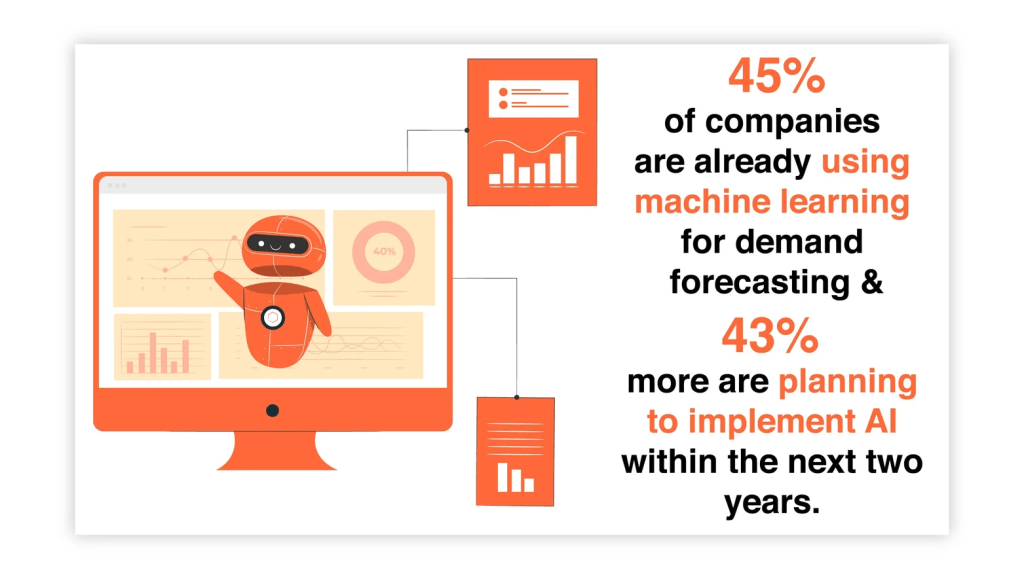
What is AI in Demand Forecasting?
Artificial Intelligence in demand forecasting leverages machine learning algorithms, data analytics, and other AI-driven technologies to predict future customer demand more accurately. Unlike traditional methods, AI can analyze vast amounts of data from various sources, including social media trends, economic indicators, weather patterns, and more, to provide a comprehensive and real-time forecast.
Benefits of AI in Demand Forecasting
Improved Accuracy
One of the primary benefits of AI in demand forecasting is its ability to enhance the accuracy of predictions. AI systems can process and analyze data much faster and more efficiently than human analysts. They can identify patterns and correlations that might be missed by traditional methods, leading to more precise forecasts. This improved accuracy helps businesses reduce overstock and stockouts, ultimately saving costs and improving customer satisfaction.
Real-Time Data Processing
Traditional demand forecasting methods often rely on historical data, which may not always reflect current market conditions. AI, on the other hand, can process real-time data, allowing businesses to adapt quickly to changes in demand. This capability is particularly valuable in industries with rapidly changing trends, such as fashion, electronics, and consumer goods.
Enhanced Decision Making
AI in demand forecasting provides businesses with actionable insights that can enhance decision-making processes. By understanding future demand trends, companies can better plan their inventory, production schedules, and supply chain logistics. This proactive approach helps prevent disruptions and ensures that products are available when and where customers need them.
How AI in Demand Forecasting Works
Data Collection
The first step in AI-driven demand forecasting is data collection. AI systems gather data from various sources, including historical sales records, market analysis reports, customer feedback, social media, and more. The more data the AI system has access to, the more accurate its predictions will be.
Data Processing and Analysis
Once the data is collected, AI algorithms process and analyze it to identify patterns and trends. Machine learning models are trained on this data to understand the factors that influence demand. These models can then make predictions based on new data inputs, continuously improving their accuracy over time.
Forecast Generation
After processing and analysis, the AI system generates demand forecasts. These forecasts can be presented in various formats, such as graphs, charts, and reports, making it easy for business leaders to interpret and use the information. The AI system can also provide recommendations for optimizing inventory levels, production schedules, and supply chain operations.
Applications of AI in Demand Forecasting
Retail Industry
In the retail industry, AI in demand forecasting can help businesses predict customer preferences and buying patterns. This information allows retailers to stock the right products in the right quantities, reducing the risk of overstocking or running out of popular items. Additionally, AI can help retailers plan promotions and sales events more effectively by predicting their impact on demand.
Manufacturing
For manufacturers, AI-driven demand forecasting can optimize production schedules and inventory management. By accurately predicting future demand, manufacturers can ensure they have the necessary raw materials and components on hand, reducing production delays and minimizing excess inventory. This efficiency leads to cost savings and improved operational performance.
Supply Chain Management
AI in demand forecasting also plays a crucial role in supply chain management. Accurate demand forecasts help supply chain managers plan logistics, transportation, and warehousing more effectively. This optimization leads to reduced lead times, lower transportation costs, and better alignment between supply and demand.
Challenges and Considerations
Data Quality
The accuracy of AI-driven demand forecasting depends heavily on the quality of the data used. Inaccurate or incomplete data can lead to erroneous predictions, which can negatively impact business operations. Therefore, it’s essential for companies to invest in data quality management and ensure that their data sources are reliable and up-to-date.
Integration with Existing Systems
Integrating AI demand forecasting systems with existing business processes and software can be challenging. Companies need to ensure that their AI solutions are compatible with their current infrastructure and that employees are trained to use the new technology effectively.
Cost and Investment
Implementing AI in demand forecasting requires a significant investment in technology, data infrastructure, and training. While the long-term benefits can outweigh the initial costs, businesses need to carefully consider their budget and resources before adopting AI solutions.
Conclusion
AI in demand forecasting represents a significant advancement in the way businesses predict and respond to market demands. By leveraging the power of AI, companies can achieve more accurate forecasts, improve their decision-making processes, and optimize their inventory and supply chain operations. Despite the challenges, the potential benefits of AI in demand forecasting make it a worthwhile investment for businesses looking to stay competitive in today’s fast-paced market environment. As technology continues to evolve, the role of AI in demand forecasting is expected to become even more integral to business success.
 New Tech news
Leave a comment