Generative AI is revolutionizing various industries, and healthcare is no exception. By leveraging advanced algorithms and vast amounts of data, generative AI has the potential to significantly enhance patient care, streamline medical processes, and drive innovations in treatment. This article explores the ways in which generative AI is transforming healthcare, providing clear examples and insights into its current and potential future applications.
What is Generative AI?
Generative AI refers to a subset of artificial intelligence that focuses on generating new content, ideas, or solutions. Unlike traditional AI, which follows predefined rules or patterns, generative AI uses deep learning models to analyze large datasets, learn from them, and create new data that is similar to the original. This capability makes it a powerful tool in fields where creativity, prediction, and optimization are crucial.
Applications of Generative AI in Healthcare
1. Drug Discovery and Development
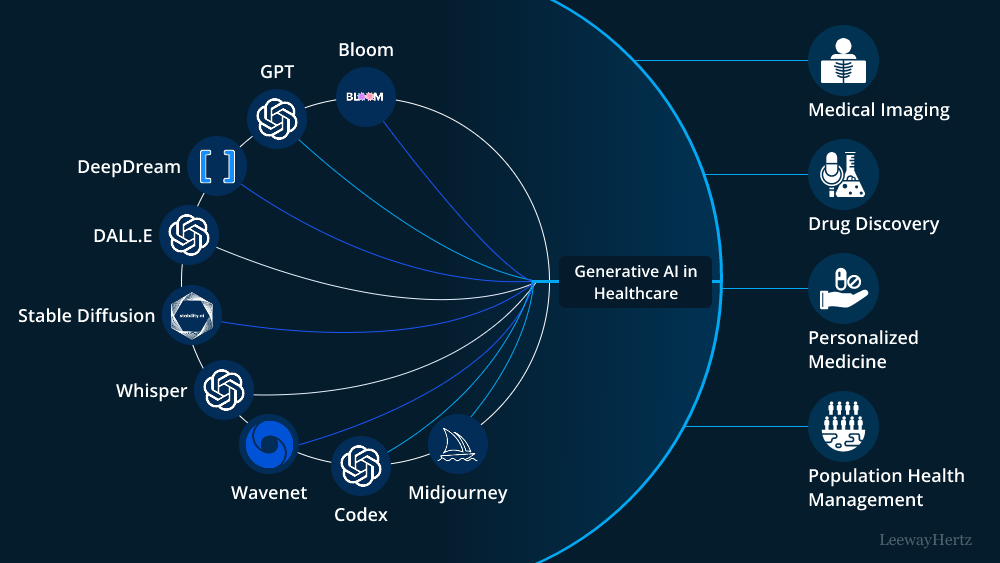
One of the most promising applications of generative AI in healthcare is in the field of drug discovery and development. Traditional methods of discovering new drugs are time-consuming and costly. Generative AI can analyze vast datasets of existing drugs and biological data to identify potential new compounds more quickly and accurately. For instance, AI algorithms can generate novel molecular structures that have the potential to become effective medications, significantly reducing the time required to bring new drugs to market.
2. Personalized Medicine
Personalized medicine aims to tailor treatments to individual patients based on their unique genetic makeup, lifestyle, and environmental factors. Generative AI can process complex datasets, including genomic data, to predict how a patient will respond to a particular treatment. This allows healthcare providers to customize treatments to achieve the best possible outcomes. For example, generative AI can help oncologists design personalized cancer treatment plans by predicting which therapies are most likely to be effective for specific patients.
3. Medical Imaging and Diagnostics
Generative AI is also making significant strides in the field of medical imaging and diagnostics. By analyzing medical images such as X-rays, MRIs, and CT scans, generative AI can detect abnormalities with a high degree of accuracy. It can generate detailed images and reports, assisting radiologists in diagnosing conditions like tumors, fractures, and other anomalies. This technology not only improves diagnostic accuracy but also speeds up the process, enabling quicker treatment decisions.
4. Virtual Health Assistants
Another exciting application of generative AI in healthcare is the development of virtual health assistants. These AI-powered assistants can interact with patients, answer questions, and provide personalized health advice based on their medical history and current symptoms. Virtual health assistants can help manage chronic conditions, remind patients to take medications, and even provide mental health support. This technology enhances patient engagement and ensures continuous monitoring outside of traditional healthcare settings.
Benefits of Generative AI in Healthcare
Enhanced Efficiency
Generative AI automates many routine tasks in healthcare, freeing up time for medical professionals to focus on more complex and critical aspects of patient care. For example, AI can handle administrative tasks such as scheduling, billing, and managing electronic health records, reducing the burden on healthcare staff and improving overall efficiency.
Improved Accuracy
By analyzing large datasets with precision, generative AI reduces the likelihood of human error in diagnosing and treating patients. This leads to more accurate diagnoses, better treatment plans, and improved patient outcomes. The ability of AI to continuously learn and adapt from new data ensures that healthcare practices are always based on the latest and most comprehensive information available.
Cost Reduction
The integration of generative AI in healthcare can lead to significant cost savings. By streamlining processes, reducing the time needed for drug discovery, and improving the efficiency of medical procedures, AI helps lower operational costs. Additionally, personalized treatments can reduce the need for expensive and ineffective therapies, further contributing to cost savings.
Challenges and Considerations
Despite its many advantages, the adoption of generative AI in healthcare comes with challenges. Privacy and security concerns are paramount, as AI systems require access to sensitive patient data. Ensuring that this data is protected from breaches and misuse is critical. Additionally, there is a need for regulatory frameworks to govern the use of AI in healthcare, ensuring that it is used ethically and safely.
Healthcare professionals must also be trained to work alongside AI systems, understanding their capabilities and limitations. The integration of AI should complement human expertise, not replace it. Building trust in AI systems among both healthcare providers and patients is essential for successful adoption.
Conclusion
Generative AI in healthcare holds immense potential to transform the industry, offering improved patient care, efficiency, and cost savings. From drug discovery and personalized medicine to diagnostics and virtual health assistants, the applications of generative AI are vast and continually evolving. By addressing challenges related to privacy, security, and ethical use, the healthcare sector can fully harness the power of generative AI to revolutionize medical practice and enhance patient outcomes.
 New Tech news
Leave a comment