In the ever-evolving landscape of technology, Artificial Intelligence (AI) stands as a transformative force, reshaping the way businesses operate across various sectors. From healthcare to finance, manufacturing to retail, AI applications are revolutionizing processes, enhancing efficiencies, and unlocking new possibilities. Let’s delve into the diverse array of AI use cases across major industries.
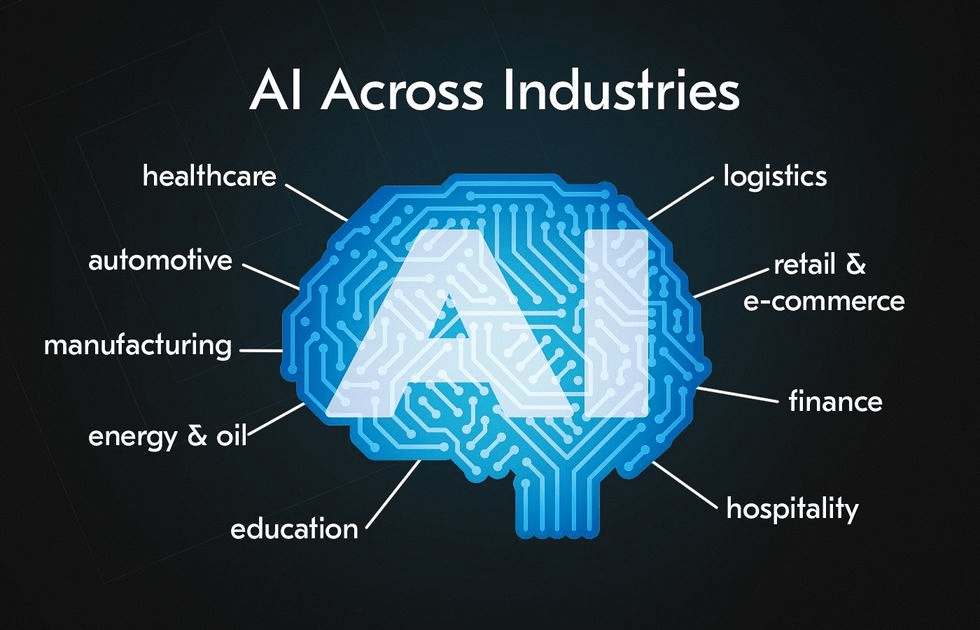
AI use cases across various industries are mentioned below:
Healthcare: Revolutionizing Patient Care
AI is revolutionizing healthcare by streamlining processes, improving diagnostics, and personalizing patient care. In diagnostics, AI-powered tools analyze medical images, such as X-rays and MRIs, to detect anomalies with greater accuracy and speed than human counterparts. Natural Language Processing (NLP) algorithms enable computers to extract insights from vast amounts of medical literature, aiding in research and clinical decision-making. Additionally, AI-driven predictive analytics models help in forecasting patient outcomes and optimizing treatment plans, ultimately leading to better healthcare delivery.
Finance: Enhancing Decision-Making and Risk Management
In the finance sector, AI is transforming operations through automation, fraud detection, and algorithmic trading. Machine Learning algorithms analyze vast datasets to identify patterns and trends, enabling more accurate risk assessment and fraud prevention. Chatbots powered by AI facilitate customer service interactions, providing personalized assistance and support. Moreover, AI-driven robo-advisors offer automated investment recommendations tailored to individual preferences and risk profiles, democratizing access to financial advice.
Manufacturing: Optimizing Production Processes
AI is driving innovation in manufacturing by optimizing production processes, improving quality control, and enabling predictive maintenance. AI-powered predictive maintenance systems analyze equipment data in real-time to anticipate potential failures and schedule maintenance proactively, minimizing downtime and reducing costs. Computer Vision technology enhances quality control by inspecting products for defects with precision and speed. Furthermore, AI-driven robots and cobots (collaborative robots) automate repetitive tasks, increasing efficiency and productivity on the factory floor.
Retail: Personalizing Customer Experiences
In retail, AI is revolutionizing customer experiences through personalization, demand forecasting, and supply chain optimization. AI algorithms analyze customer data, including browsing history and purchase behavior, to offer personalized product recommendations and targeted marketing campaigns. Demand forecasting models leverage AI to predict consumer trends and optimize inventory management, ensuring products are available when and where they are needed. Additionally, AI-powered logistics and supply chain management systems enhance efficiency, reducing costs and improving delivery times.
Transportation: Driving Efficiency and Safety
AI is reshaping the transportation industry by driving efficiency, improving safety, and advancing autonomous technologies. In logistics, AI algorithms optimize route planning and scheduling, reducing fuel consumption and emissions while improving delivery times. Machine Learning models analyze sensor data from vehicles to detect potential issues and prevent accidents through predictive maintenance and driver assistance systems. Moreover, AI is at the forefront of autonomous vehicle development, with companies investing in research and testing to realize the vision of self-driving cars and trucks.
Education: Personalizing Learning Experiences
In education, AI is transforming teaching and learning through personalized instruction, adaptive learning platforms, and educational analytics. AI-powered tutoring systems adapt learning materials and pace to individual student needs, providing targeted support and feedback. Natural Language Processing algorithms enable automated grading of assignments and essays, freeing up educators’ time for more personalized interactions with students. Furthermore, AI-driven learning analytics tools track student progress and performance, enabling educators to identify areas for improvement and tailor instruction accordingly.
Conclusion
The applications of AI across major industries are vast and diverse, encompassing healthcare, finance, manufacturing, retail, transportation, and education. From revolutionizing patient care and enhancing financial decision-making to optimizing production processes and personalizing customer experiences, AI is reshaping the way businesses operate and deliver value to customers. As technology continues to evolve, the potential for AI to drive innovation and create positive impact across industries is boundless, heralding a future where intelligent automation and data-driven insights redefine the possibilities of what is achievable.
 New Tech news
Leave a comment