In the fast-paced world of machine learning and natural language processing, the concept of embeddings-as-a-service is rapidly gaining traction. As businesses strive to extract meaningful insights from vast amounts of data, the ability to represent data in a more efficient and meaningful way has become paramount. In this article, we’ll explore the transformative potential of embedding services, delve into their applications across various domains, and discuss the benefits they offer to businesses.
Understanding Embeddings-as-a-Service
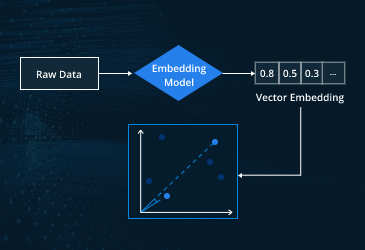
Embeddings as a service refers to the provision of pre-trained embedding models through a cloud-based service. Embeddings, in this context, are dense, low-dimensional representations of high-dimensional data, such as words, sentences, or documents. These embeddings capture semantic and contextual information, making them invaluable for a wide range of machine learning tasks, including text classification, sentiment analysis, and recommendation systems.
Applications Across Domains
Natural Language Processing (NLP)
In the field of NLP, embeddings play a crucial role in representing textual data in a way that captures semantic similarities and relationships. Embedding services provide pre-trained word embeddings, such as Word2Vec, GloVe, and FastText, which can be readily used in NLP tasks like language translation, named entity recognition, and document clustering.
Image Recognition
Embeddings-as-a-service is also making waves in the field of computer vision. Pre-trained image embeddings, generated by models like ResNet, Inception, and VGG, allow businesses to extract meaningful features from images and use them for tasks such as object detection, image classification, and content-based image retrieval.
Recommender Systems
For businesses operating in e-commerce, media, and entertainment, embedding services offer a powerful tool for building recommender systems. By representing users and items as embeddings in a latent space, businesses can generate personalized recommendations that take into account user preferences, behavior, and item characteristics.
Benefits of Embeddings-as-a-Service
- Time and Cost Savings: By leveraging pre-trained embeddings through a service-based model, businesses can save time and resources that would otherwise be spent on training embedding models from scratch.
- Scalability: Embedding services are designed to scale according to the needs of the business, allowing for seamless integration into existing workflows and systems.
- Improved Performance: Pre-trained embeddings are often trained on large corpora of text or images, resulting in high-quality representations that lead to improved performance on downstream tasks.
- Flexibility and Customization: While pre-trained embeddings offer convenience, businesses also have the flexibility to fine-tune or customize embeddings to better suit their specific needs and domain requirements.
- Access to State-of-the-Art Models: Embedding services provide access to state-of-the-art embedding models, allowing businesses to stay at the forefront of advancements in machine learning and NLP.
Conclusion
Embeddings-as-a-service represents a paradigm shift in the way businesses approach data representation and machine learning. By providing access to pre-trained embedding models through a convenient and scalable service-based model, embedding services empower businesses to extract valuable insights from their data with ease and efficiency. As the demand for more sophisticated AI solutions continues to grow, embedding services are poised to play an increasingly important role in driving innovation and powering intelligent applications across industries.
 New Tech news
Leave a comment